
Inmate Population trends in Sedgwick County are tracked through a daily custody count that records every admission, release, and transfer at the Adult Detention Facility. The Sedgwick County inmate population count updates each morning, showing current jail occupancy, pre‑trial versus sentenced categories, and any federal holds. Users can view the current detention population on the official search portal, which reflects real‑time inmate population data and highlights fluctuations that affect bed availability.
The Sedgwick County jail statistics also include historical daily, monthly, and annual reports that reveal long‑term incarceration trends. Researchers access downloadable datasets showing inmate demographic breakdowns, age groups, and gender ratios, as well as facility‑specific capacity versus occupied beds. By comparing current jail population reports with archived jail statistical reports, stakeholders gain insight into intake spikes, release patterns, and the overall correctional population health.
How to Search Inmate Population
Sedgwick County’s inmate population service supports person-level searches through the official Adult Detention Facility portal and lets readers confirm the custody details shown for a matched record. You can also access inmate lookup to review official records. The county’s daily custody count records admissions, releases, and transfers, so it answers a different need from a name search. Published reports add historical counts, facility occupancy, age and gender breakdowns, and period movement totals. Each result should be tied to its reporting date and stated scope.
Official Search Portal: https://ssc.sedgwickcounty.org/InmateSearch/
Steps to Search
- Open the official search portal and review the search form before entering any details.
- Complete the displayed fields with the person’s name and any second identifier the form requests. Use the spelling shown by the county whenever possible.
- Submit the form and compare each match rather than assuming the first result is the correct person.
- Read the status, location, and other record details shown for the selected match. Note the date you viewed the page.
- If no result appears, retry with one corrected spelling or identifier at a time, then ask the Adult Detention Facility to resolve a record that remains absent.
Sedgwick County Inmate Population Metrics
Sedgwick County inmate population metrics combine a dated custody count with movement events, facility occupancy, and demographic data. The core measure is the number of people in custody at the Adult Detention Facility on a stated reporting date. Supporting figures divide that population by custody status and describe age and gender composition. Historical files place the current count beside earlier daily, monthly, and annual snapshots.
Daily Custody Count and Reporting Source
The daily custody count is a dated snapshot rather than a running total of every booking made during the day. A booking is an intake event. A custody population is the group of people held at a stated time. Because the count records admissions, releases, and transfers, the number can change from one reporting date to the next without any change in physical capacity.
The morning update gives readers a dated figure for comparison. The count should not be confused with the number of people booked, the number of court appearances, or the number of cases handled during the same period. A current inmate population count measures custody, while a booking report measures events. Each figure needs its own label, reporting date, and source.
Pretrial, Sentenced, and Federal-Hold Categories
The Sedgwick County jail population count separates people recorded as pretrial from people recorded as sentenced and identifies federal holds. The pretrial figure shows the size of the population awaiting case resolution. The sentenced figure shows the number held under a sentence. The federal-hold field marks records with that custody designation.
Readers should not add these figures unless the file confirms that each category stands alone. Custody status and a hold designation can describe different parts of a record. The report’s category notes control how the figures may be combined.
Age Categories and Gender Distribution
Downloadable demographic data provides inmate age categories and gender ratios for the reported population. Raw numbers show the scale of each group. Percentages show each group’s share of the total. A percentage without its underlying count can hide a change in the size of the reported population.
Researchers should keep the file’s age brackets and gender categories unchanged. Renaming a category or combining separate groups can make two reports appear comparable when they are not. The reporting period, denominator, and total population should accompany every percentage cited from a Sedgwick County inmate demographic file.
Daily, Monthly, and Annual Comparisons
Daily files record the custody population on each reporting date. Monthly reports combine many daily snapshots into a period summary, which makes recurring intake spikes and release patterns easier to identify. Annual reports support year-to-year comparisons and show how historical population totals relate to reported capacity.
Comparisons must use matching measures. A monthly average daily population differs from the count on the last day of the month. A year-end custody count differs from the sum of all daily counts during the year. The same rule applies to admissions, releases, and transfers: each is an event measure and should not be treated as a headcount.
Facility Occupancy and Inmate Movement
Facility occupancy measures how many detention positions are filled at a reporting date. Inmate movement measures how that number changed during a period. Sedgwick County reports include facility-specific capacity and occupied-bed figures, so a jail population count should not be converted into an occupancy rate unless the count and capacity cover the same facility, scope, and date.
Jail Capacity, Occupied Beds, and Availability
An occupied-bed count shows how many detention positions are in use. An available-bed figure shows unused capacity under the report’s stated calculation. A capacity percentage can be produced only after the occupied-bed total and total capacity have been matched to the same reporting date.
Occupied beds and the custody population can differ because of reporting time, custody status, transfers, or the scope of each file. A person may remain in county custody while being assigned to a location other than the Adult Detention Facility. Such a case can change a facility count without changing a broader county custody total.
Use the official capacity and occupied-bed rows rather than estimating availability from a rounded public population. You can also explore inmate search through available county records. Keep the facility name with every occupancy figure, since a bed-capacity number from one site cannot describe another site’s available jail beds.
Facility-Specific Detention Totals
The inmate population by facility should be cited with the facility name, reporting date, and source. A detention total for the Sedgwick County Adult Detention Facility describes that location’s reporting scope. A county custody count may use a broader scope that includes other placements or legal statuses.
If a statistical file contains more than one facility row, read the row label and footnotes before using the number. One adult detention facility count should not be labeled countywide unless the report expressly defines it that way. This distinction also applies to occupied beds and available capacity.
Daily Admissions, Releases, and Transfers
Admissions, releases, and transfers describe movement through the detention system. An admission begins a custody event. A release ends one. A transfer moves a person between locations, facilities, or custody assignments and may or may not change the broader county population. Reading these records together explains why a daily count rises or falls.
- An admission records a person entering custody during the stated period. Compare it with the beginning and ending population rather than treating it as the total population.
- A release records a person leaving custody during the stated period. Release volume helps explain lower occupancy, but it does not show who remains housed.
- An incoming transfer adds a person to a facility’s assigned population. It may represent movement from another location rather than a new countywide admission.
- An outgoing transfer removes a person from a facility’s assigned population. The countywide custody total may stay unchanged when both sides of the transfer appear within the county.
- Net movement combines the relevant entries and exits for the period. The result should be checked against the change between the opening and closing population snapshots.
Public Availability and Statistical Files
Public records serve two different purposes. The official inmate search supports a person-level check. Statistical reports and downloadable files support population, occupancy, demographic, and trend analysis. A name search can confirm that a record appears, but it cannot by itself produce a complete countywide population count.
Current Online Records and Daily Summaries
The official portal supports current inmate searches and shows the details available for each matched record. A listed name does not by itself prove current custody. A record can remain visible after a person leaves custody, so readers should check the status displayed on the result rather than rely on the presence of a name.
Daily population summaries serve a broader purpose. They report the custody total, occupied beds, and movement associated with a stated date. For research or citation, record the report date and the date the data were viewed. A portal lookup made after the morning count may show a newer status than the dated statistical file.
Historical Reports and Research Files
Sedgwick County’s historical jail reports cover daily, monthly, and annual periods. Downloadable datasets also provide inmate demographic breakdowns, age groups, gender ratios, and facility capacity compared with occupied beds. These files support research on population levels, intake and release patterns, and facility use.
Keep the original file name, reporting period, publication date, and download date with each saved dataset. Review any notes that define custody categories or facility scope. Older files may use different labels or reporting methods, so category definitions should be reconciled before two periods are placed side by side.
Daily reports support dated snapshots. Monthly reports reveal recurring movement across a shorter span. Annual reports place several reporting years in one frame. A complete research file often needs more than one report type because no single table covers individual status, demographics, movement, and physical occupancy at once.
Person Search, Bookings, and Population Totals
The easiest source error occurs when a person search is treated as a total population report. Each source has a different unit and purpose. Matching the correct source to the question prevents a roster result from being confused with a daily count or a booking history.
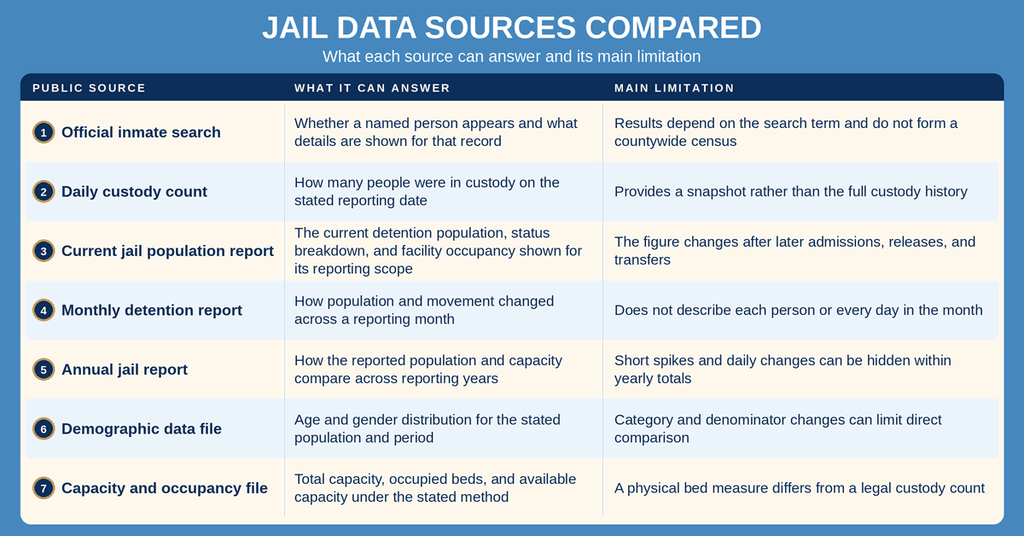
Limits of Public Rosters and Non-Public Exclusions
The public inmate search and the aggregate custody count do not always cover the same records. A name search returns matching entries. A population count summarizes every person who meets the reporting rules. A released person may remain visible as a record, while a person included in a custody total may be absent from a public list. These differences do not prove that either source is wrong.
Public descriptions do not provide a full list of every non-public custody exclusion. Readers should not estimate hidden categories, subtract one roster from a total, or assume that every current inmate appears under every search method. Use the report’s stated scope and note any unresolved difference between a personal search and an aggregate figure.
Data Accuracy and Reporting Timelines
Population data is time-sensitive because admissions, releases, and transfers can change the count during the day. A figure is valid for the date, time, facility, and custody rules stated with it. Individuals can also check recent arrests data to verify relevant details. Comparing one report with another without checking those details can create a false increase, decrease, or occupancy difference.
Reporting Date, Update Time, and Daily Snapshots
The daily count updates each morning. Later custody events can change who is held after that update, so the morning total and a person viewed later need not match. The current jail population on the portal and a dated statistical report can therefore have different reporting moments.
Record both the publication date of a statistical file and the date a portal was checked. Use wording such as “as of” followed by the reporting date. A morning count should not be described as an end-of-day total unless the report defines it that way. Screenshots can preserve the page context, but the saved date and visible figures remain the key evidence.
Processing Delays and Count Adjustments
Daily jail reports can be affected by events recorded after the count was prepared. A late booking, release confirmation, transfer posting, or correction to an earlier record can create a temporary mismatch between sources. The outline of a report and any revision notice show whether later changes were applied.
When two official figures differ, compare the event date with the processing date. Keep both the original file and any revised version. The later official revision controls the same reporting date if the agency identifies it as a corrected file. Record the change so historical analysis does not treat a corrected figure as a separate reporting day.
Cross-Facility and Cross-Source Differences
Three reporting scopes require separate treatment. A person record identifies one individual. A facility count measures people associated with a physical detention site. A county custody count measures the people who meet the county’s reporting rules. A person can fall into the broader custody count without occupying a bed at the Adult Detention Facility.
Pretrial, sentenced, and federal-hold fields describe attributes within a reported population. They do not become separate physical populations unless a file defines them that way. Never reconcile an aggregate total by subtracting portal results, because portal results depend on the name, identifier, status filter, and date used for the search.
Valid comparisons require the same unit, date, facility, and category definitions. Occupied beds should be compared with capacity. Custody totals should be compared with custody totals. A demographic file should be compared with another file using matching age and gender categories. This method prevents a difference in measurement from being reported as a change in incarceration.
Resolving Missing Names and Unlisted Data
If a named inmate is missing from a search or a statistical file omits a record, check both the individual record and the source before treating the omission as a count error. Search spelling, identifier format, custody status, and reporting date can each affect the result. The cause may sit in the search record, the aggregate report, or the rules used to build each one.
- Confirm the person’s full name and the spelling used on the county record.
- Try one corrected identifier at a time rather than changing every field together.
- Check the displayed status and reporting date before assuming the person is absent from custody.
- Compare the file’s facility and custody scope with the location being described.
- Save the page or file reviewed, then contact facility records staff with the name, identifier, date, and source used for the search.
Contact Information
Use the contact details below for questions about a current inmate record, a reported population figure, or a historical statistical file. Have the relevant name, identifier, reporting date, and portal result ready when calling.
Frequently Asked Questions
This section answers the most common questions about the inmate population at the Sedgwick County Adult Detention Facility, including how to see current numbers, where to find daily updates, and what the data means.
What is the current Sedgwick County inmate population?
The latest count shows the total number of individuals held at the Sedgwick County Adult Detention Facility. This figure includes both pre‑trial detainees and sentenced inmates. The count is refreshed each day and can be accessed through the county’s online inmate search portal. For the most recent number, visit the official website and enter the “Inmate Search” tool, which displays the current population alongside basic custody details.
How often does Sedgwick County update jail population data?
Jail population data is updated daily by the Sedgwick County Sheriff’s Office. Each update records admissions, releases, and transfers that occurred the previous day. The daily report is posted on the official inmate search website and is also compiled into weekly and monthly summaries for public review. This frequent refresh ensures that families, attorneys, and the public have access to the most accurate information available.
Where can I find daily inmate count for Sedgwick County?
The daily inmate count is available on the Sedgwick County Adult Detention Facility’s online portal. Visit the Inmate Search page, where a summary box shows the total number of occupants for that day. The site also provides a breakdown by custody status and facility location. No registration is required, and the page is accessible 24 hours a day, seven days a week.
What categories are used for inmate custody status?
Inmate custody status in Sedgwick County is divided into three main categories: pre‑trial, sentenced, and transfer. Pre‑trial inmates are awaiting court appearances, sentenced inmates are serving a court‑ordered term, and transfer inmates are moving between facilities or awaiting relocation. Each category appears in the daily report and helps officials track the flow of individuals through the system.
How can I view historical jail population trends?
Historical trends are compiled in the Sedgwick County jail population reports, which are released monthly and annually. These reports include charts of total counts, admission and release rates, and demographic breakdowns over time. They can be downloaded from the county’s official website under the “Statistics” or “Reports” section. Researchers and the public use these documents to analyze changes in incarceration patterns.